Guide to Air Fryer Temperature Conversion Chart in 2026
Convert any oven recipe for your air fryer with this temperature conversion chart. Quick adjustments for meat, veggies, frozen foods, and baked goods.
URL Slug
air-fryer-temperature-conversion-chart
H1
Air Fryer Temperature Conversion Chart: Oven to Air Fryer Made Simple
Short Introduction
Every time I pull out a vintage family casserole recipe or a new sheet-pan dinner from a favorite blog, the first question is always the same: what temperature do I set my air fryer? Ovens and air fryers don’t cook the same way, so you can’t just plug in the same number and walk away. This air fryer temperature conversion chart takes the guesswork out of adapting any recipe.
Whether you’re roasting chicken thighs, baking cookies, or reheating leftovers, a simple rule and a quick table get you there.
Table of Contents
- Why Can’t You Use the Same Temperature?
- The Simple Conversion Formula
- Air Fryer Temperature Conversion Chart (Printable Table)
- Air Fryer Cooking Times Conversion
- Converting Meat and Poultry Recipes
- Converting Vegetable and Side Dish Recipes
- Converting Frozen Foods
- Converting Baked Goods
- Practical Tips for Better Conversions
- Common Mistakes and How to Avoid Them
- Safety Tips for Air Fryer Cooking
- FAQ
- Final Verdict
- Key Takeaways
Why Can’t You Use the Same Temperature?
Featured Snippet Answer: Air fryers circulate hot air much faster than ovens, so they cook food more efficiently. Using the same oven temperature in an air fryer often burns the outside before the inside is done. You generally reduce the temperature by 25°F (about 14°C) to compensate for the concentrated heat.
An oven relies on still or slowly moving air inside a large cavity. An air fryer, on the other hand, blasts superheated air at high speed, surrounding food from all angles. That rapid convection transfers heat much faster.
If you set your air fryer to 400°F for a recipe that calls for 400°F in the oven, the exterior will brown and crisp too quickly. The center might still be raw. A lower temperature (375°F or even 350°F) gives the heat time to reach the middle without torching the crust.
The Simple Conversion Formula
The industry-standard rule among home cooks and appliance manufacturers is straightforward: reduce the oven temperature by 25°F (or roughly 14°C). Keep the cooking time the same or slightly shorter, then check for doneness early.
Formula:
- Air Fryer Temp = Oven Temp, 25°F
- Start checking at about 75% of the original cook time
Example:
Oven recipe bakes at 375°F × 30 minutes
→ Air fryer at 350°F × 30 minutes (check at 22 minutes)
For recipes that already use high heat (425°F or above), dropping 25°F may not be enough. You can reduce by 30, 35°F for crispier or more delicate items.
Air Fryer Temperature Conversion Chart (Printable Table)
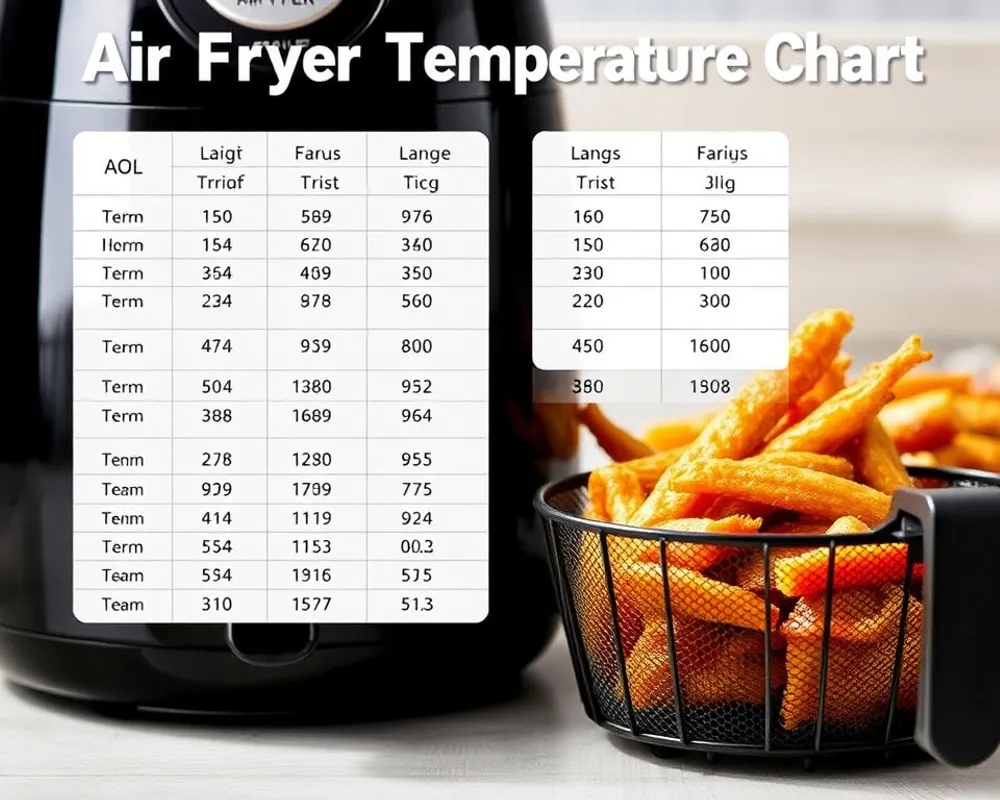
Below is a quick-reference table for common oven temperatures and their air fryer equivalents. Use it any time you adapt a standard oven recipe.
| Oven Temperature | Air Fryer Temperature | Notes |
|---|---|---|
| 300°F (150°C) | 275°F (135°C) | Low and slow roasts |
| 325°F (165°C) | 300°F (150°C) | Casseroles, braises |
| 350°F (175°C) | 325°F (165°C) | Most baked goods, chicken |
| 375°F (190°C) | 350°F (175°C) | Roasted veggies, meatloaf |
| 400°F (200°C) | 375°F (190°C) | Frozen fries, breaded items |
| 425°F (220°C) | 400°F (200°C) | Pizza, crispy wings |
| 450°F (230°C) | 425°F (220°C) | Thin steaks, quick searing |
If your air fryer only shows Celsius, subtract 10, 15°C from the oven Celsius number. For example, 200°C oven becomes 185, 190°C air fryer.
Air Fryer Cooking Times Conversion
Temperature isn’t the only thing that changes. Air fryers cook faster because the heat hits every surface. Here’s a general rule for timing:
- Same time: Works for sturdy items like potatoes, whole chicken pieces.
- Reduce by 20%: Best for breaded or battered foods (chicken tenders, onion rings, fish fillets).
- Reduce by 30%: Works for delicate items (thin fish, cookies, vegetables).
- Always check early: Use an instant-read thermometer for meat.
When converting recipes for the air fryer, I always set my timer for 75% of the original time. If it needs more, I add a minute at a time. That extra minute never ruins dinner; overcooking does.
Converting Meat and Poultry Recipes
Whole Chicken or Turkey Breast
Oven at 350°F → Air fryer at 325°F. Cooking time stays roughly the same (about 20 minutes per pound). Use a meat thermometer to hit 165°F in the thickest part of the breast.
I like to spatchcock smaller birds so they cook evenly. If you’re cooking chicken bites, check out our air fryer chicken bites recipe for a perfect temp and time.
Chicken Thighs, Drumsticks, Wings
Oven at 400°F → Air fryer at 375°F. Cook skin-side up, don’t overcrowd. Wings need only 22, 25 minutes at 375°F for crispy skin.
For frozen wings, add 5 minutes and shake the basket halfway.
Steaks and Chops
Oven at 425°F for searing → Air fryer at 400°F. Thick cuts (1½ inches) benefit from a lower temp (375°F) to cook through without burning the crust. Always rest meat 5 minutes before serving.
Ground Meat (Meatballs, Burgers)
Oven at 375°F → Air fryer at 350°F. Form smaller patties or meatballs (2, 3 ounces) and flip halfway. A typical burger takes 10, 12 minutes at 350°F.
Fish and Seafood
Oven at 375°F → Air fryer at 350°F for fillets, 325°F for delicate fish like cod. Fish cooks fast, start checking at 7, 8 minutes. For frozen salmon, our frozen salmon air fryer guide has exact timings.
Converting Vegetable and Side Dish Recipes
Vegetables love the air fryer. The high-speed air caramelizes sugars quickly, but you still need to adjust the temperature.
- Oven-roasted veggies at 425°F → Air fryer at 400°F. Cut pieces uniform (1, 2 inches). Toss with oil, salt, and pepper. Shake halfway. Broccoli takes 7, 9 minutes, Brussels sprouts 12, 15 minutes.
- Root vegetables (potatoes, carrots, sweet potatoes), Oven at 400°F → Air fryer at 375°F. Parboil dense roots first for a creamy center. Diced potatoes need about 18 minutes.
- Asparagus, green beans, zucchini, Oven at 400°F → Air fryer at 375°F. These cook in 6, 10 minutes. Don’t overcrowd or they steam. Our air fryer asparagus recipe nails the perfect tenderness.
For frozen vegetables, skip thawing. Toss with oil and seasonings, then cook at 375°F for 8, 12 minutes depending on size.
Converting Frozen Foods
Frozen foods are already designed for deep frying or oven baking. Most bags give oven instructions. Convert using the same 25°F rule.
- Frozen french fries at 450°F oven → 425°F air fryer. Shake halfway.
- Frozen mozzarella sticks at 400°F oven → 375°F air fryer. Cook 5, 7 minutes. Our frozen mozzarella sticks recipe works perfectly.
- Frozen corn dogs at 350°F oven → 325°F air fryer. Cook 8, 10 minutes. Check out the air fryer frozen corn dogs page for timings.
- Frozen chicken tenders at 400°F oven → 375°F air fryer. Cook 10, 12 minutes, flipping once. For exact numbers, see how long to cook chicken tenders in air fryer.
Don’t assume frozen food cooks the same as fresh. Frozen items contain ice that steams off, so you may need an extra 2, 3 minutes to get crispy results.
Converting Baked Goods
Baked goods in an air fryer? Yes, but handle them gently. The intense heat can over-brown the outside before the inside rises.
- Cookies: Oven at 350°F → Air fryer at 325°F. Chill dough before baking. Use parchment or a silicone sling. Bake for 6, 8 minutes, then check. Our air fryer chocolate chip cookies use this exact conversion.
- Muffins and cupcakes: Oven at 375°F → Air fryer at 350°F. Fill silicone muffin cups two-thirds full. Bake 10, 12 minutes (oven recipe says 15, 18).
- Biscuits: Oven at 425°F → Air fryer at 400°F. Place dough rounds in a single layer. Bake 8, 10 minutes, flipping halfway. Canned biscuits are even quicker, air fryer canned biscuits takes about 6 minutes.
- Pizza (fresh or frozen): Oven at 425°F → Air fryer at 400°F. For frozen pizza slices, cook 5, 7 minutes. For fresh homemade, preheat the basket and cook 8, 10 minutes.
Always check doneness with a skewer or toothpick for cakes and muffins. The air fryer can fool you with a dark golden top while the center is still wet.
Practical Tips for Better Conversions
- Use an oven thermometer. Air fryer thermostats vary. I’ve seen a 400°F setting actually hit 420°F. A cheap thermometer tells you the real temperature.
- Preheat your air fryer. Most models need 3, 5 minutes to reach the set temperature. Preheating helps the conversion work as expected.
- Don’t overcrowd the basket. Leave space for hot air to circulate. If the basket is full, reduce temperature another 10°F and increase time by a couple minutes.
- Shake or flip halfway. This ensures even browning and prevents sticking. Some air fryers have a shake reminder, but a timer works just fine.
- Oil lightly. Air fryers work best with a light spritz of oil (avocado, canola, or olive oil spray). Too much oil creates smoke. Too little leads to dry food.
- Tent with foil for delicate items. If the top is browning too fast, loosely cover with foil during the last few minutes.
Common Mistakes and How to Avoid Them
| Mistake | Problem | Fix |
|---|---|---|
| Using same temperature as oven | Burnt outside, raw inside | Reduce by 25°F |
| Overfilling basket | Steaming instead of crisping | Cook in batches |
| Ignoring preheat | Inconsistent cooking | Preheat 3–5 minutes |
| Not checking doneness early | Overcooked food | Set timer 75% of original time |
| Using wet batter | Soggy results | Coat with breadcrumbs or flour first |
| Forgetting to flip | Uneven browning | Flip or shake at halfway |
Some people think adding more oil will fix dryness. It won’t. The air fryer already uses minimal oil; dry food means you’re cooking too long or at too high a temperature.
Safety Tips for Air Fryer Cooking
- Use a meat thermometer for poultry, pork, and fish. The USDA recommends safe minimum internal temperatures: 165°F for poultry, 145°F for whole cuts of meat (let rest 3 minutes), 160°F for ground meats. You can reference the USDA Safe Minimum Internal Temperatures chart for official guidance.
- Don’t put wet food into hot oil. Pat food dry before adding oil. Water droplets cause spattering.
- Never fill the basket more than two-thirds full. Overloading can block airflow and cause the appliance to overheat.
- Watch for smoke. If you see smoke, the temperature is too high or there’s excess oil. Turn off, let it cool, then clean the basket and tray. If the problem persists, read our troubleshooting guide on why your air fryer is smoking.
- Unplug after use. Even when off, some air fryers remain warm. Unplug for safety.
- Keep away from water. Never immerse the base in water. Wipe with a damp cloth.
FAQ
1. What is the general rule for converting oven temperature to air fryer temperature?
Reduce the oven temperature by 25°F (about 14°C). For example, if a recipe says 375°F, set the air fryer to 350°F. This compensates for the faster, more concentrated heat.
2. Do I need to reduce cooking time too?
Yes, start checking at 75% of the original oven time. Air fryers often cook 20, 30% faster, but timing depends on the food type and quantity. Use a meat thermometer for accuracy.
3. How do I convert Celsius oven temperatures to air fryer?
Subtract 10, 15°C from the Celsius oven temperature. For example, 200°C oven becomes 185, 190°C air fryer. The 25°F reduction equals roughly 14°C, so dropping 10, 15°C works.
4. What if my air fryer only has a few presets and I can’t set an exact temperature?
Choose the preset closest to your target temperature, then adjust the time manually. Most presets run 375°F or 400°F. For a recipe needing 350°F, use the 375°F preset and check earlier.
5. Can I use the conversion chart for convection ovens?
No. Convection ovens also circulate air, but they have larger cavities and often require a 25°F reduction from conventional oven temps. Air fryers are smaller and more intense, so stick with the air fryer-specific chart.
6. Why did my air fryer burn the outside of my roast chicken?
You likely didn’t reduce the temperature, or you overcrowded the basket. Try 325°F instead of 350°F, and ensure the chicken is not touching other pieces. Cover the breast with foil if it browns too fast.
7. How do I convert a microwave recipe to air fryer?
You can’t directly convert. Microwaves use radiation to heat from within; air fryers use dry heat. Instead, look for a similar air fryer recipe or use the texture you want (crispy vs. soft) as a guide.
8. Should I always preheat the air fryer before using the conversion chart?
Yes. Preheating ensures the air fryer reaches the set temperature, which makes the conversion accurate. Skip preheating only if the recipe specifically says not to (rare).
Final Verdict
An air fryer temperature conversion chart is the single most useful tool for anyone who regularly adapts oven recipes. The 25°F reduction plus early checking covers 90% of your cooking needs. Once you internalize that rule, you can confidently air-fry anything from a sheet-pan dinner to a batch of cookies.
The chart works because it respects the physics of rapid air circulation. Lower temp, same or slightly less time, and always check early. That’s it.
Keep this article bookmarked, and you’ll never guess an air fryer setting again. For specific recipes like chicken tenders, frozen sausage, or asparagus, we’ve already done the testing, check out the linked recipes right here on CookHavenly.
Key Takeaways
- Reduce oven temperature by 25°F (14°C) for air fryer conversion.
- Start checking at 75% of the original cooking time.
- Use an instant-read thermometer for meat and poultry.
- Preheat the air fryer for consistent results.
- Don’t overcrowd the basket; air needs to circulate.
- For baked goods, reduce temperature and watch carefully to avoid burning.
- Frozen foods follow the same 25°F rule but may need an extra 2, 3 minutes.
- Always clean your air fryer basket after each use to prevent smoke and off-flavors (see how to clean an air fryer).
- air fryer chicken bites, in meat section
- frozen salmon air fryer guide, in fish section
- frozen mozzarella sticks recipe, in frozen foods
- air fryer asparagus, in vegetables
- air fryer chocolate chip cookies, in baked goods
- air fryer canned biscuits, in baked goods
- how long to cook chicken tenders in air fryer, in frozen foods
- air fryer frozen corn dogs, in frozen foods
- why your air fryer is smoking, in safety
- how to clean an air fryer, in key takeaway
USDA Safe Minimum Internal Temperatures chart – in safety tips